The 2025 tax law rewards the top
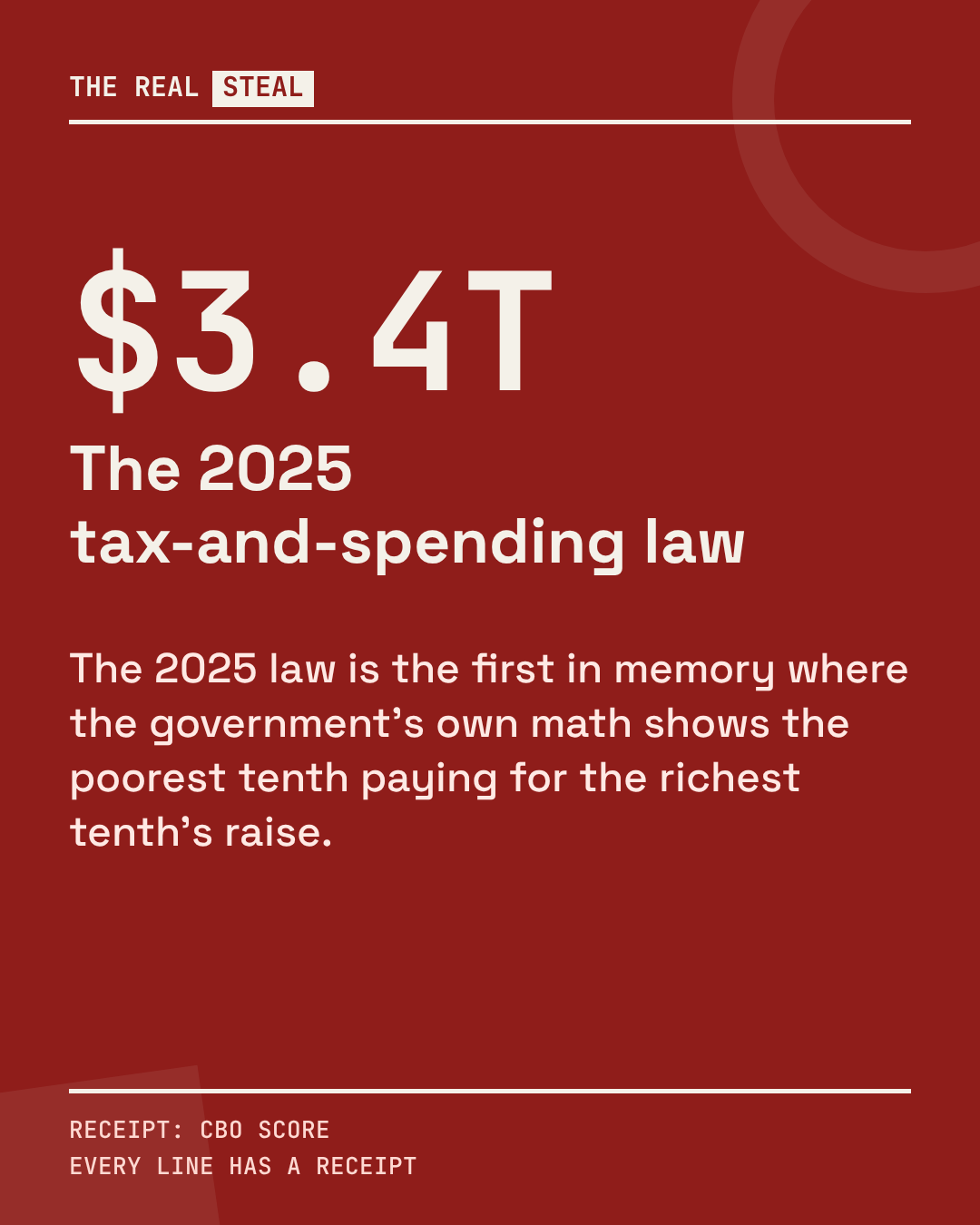
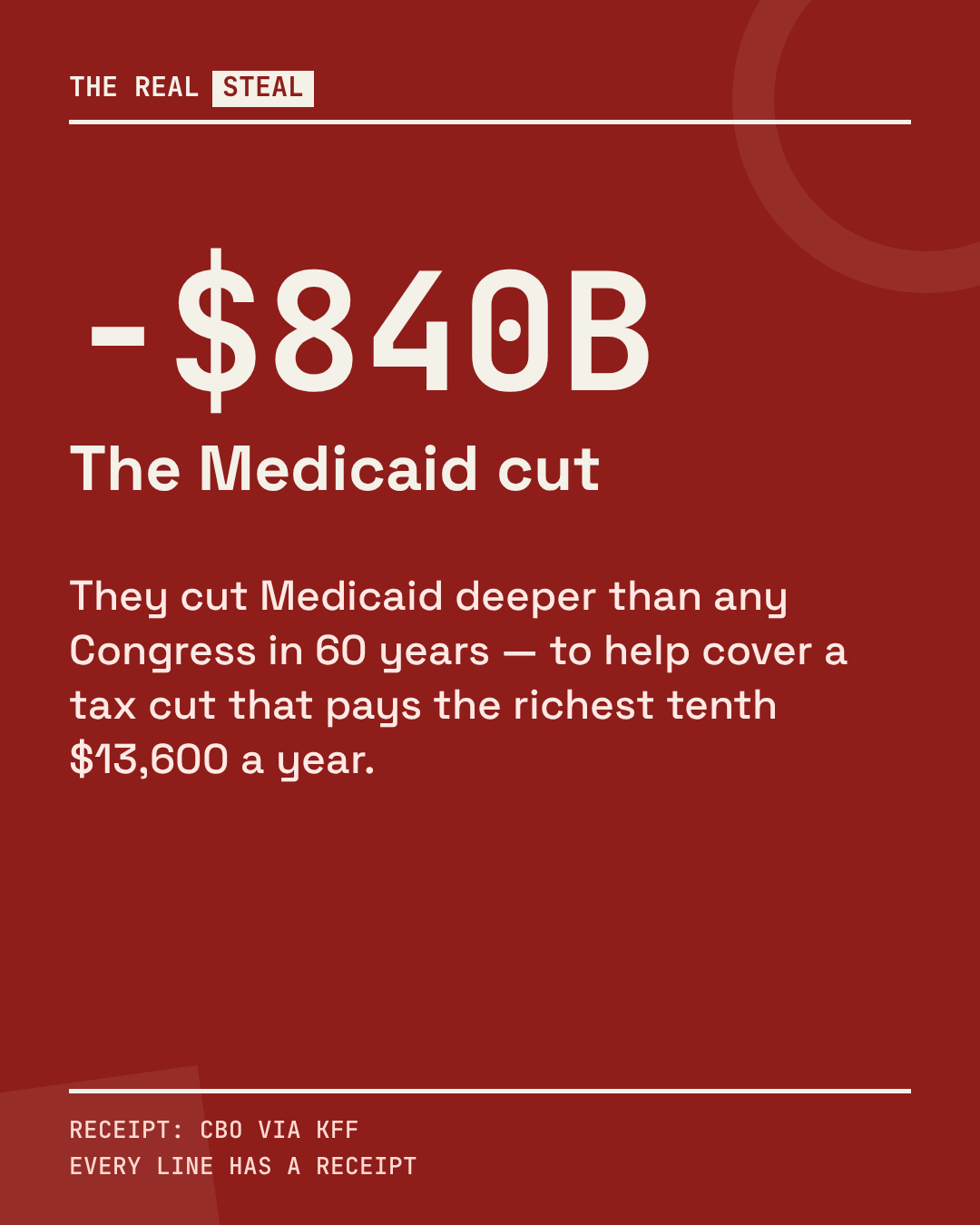
The richest tenth gains about $13,600 a year from the tax provisions, according to CBO.
Read the brief →Receipts CBO enacted-law score · CBO enacted-law distribution · KFF
Trump signed the 2025 law. Republicans in Congress passed it. Their own government’s numbers show the poorest families losing resources while the richest families gain thousands of dollars a year.
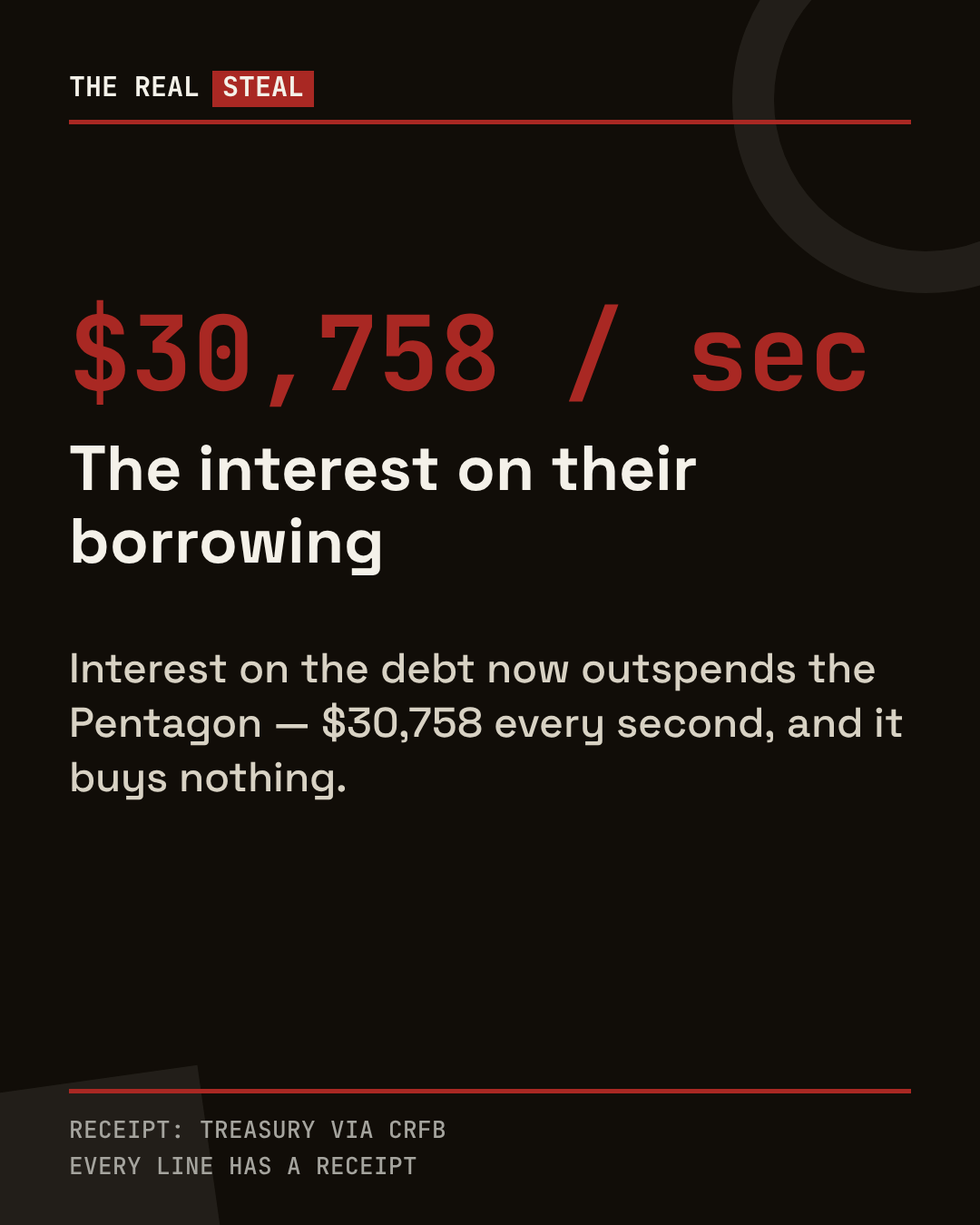
The U.S. paid $970 billion in net interest in fiscal 2025 — $30,758 every second. It now outspends defense ($917B) and Medicaid ($668B). Treasury via CRFB
Get this as a widget →The debt read $19.9T the day Trump first took office. It reached $40.0T as of Aug. 21, 2026. Treasury
$40.03T ÷ 132.9M U.S. households. Census Bureau
Two lists. First, what government choices handed to the rich. Then, what working people paid. Every item opens a full brief, and every receipt stays visible.
The richest tenth gains about $13,600 a year from the tax provisions, according to CBO.
Read the brief →Receipts CBO enacted-law score · CBO enacted-law distribution · KFF
Corporations got a permanent rate cut from 35% to 21%. The top 1% averaged about $33,000 in 2018.
Read the brief →Receipts JCT via CBPP · Tax Policy Center
Owners, shareholders, and creditors received 66% to 77% of the program’s benefits. About three-quarters landed in the richest fifth.
Read the brief →Receipts NBER w29669 (Autor et al.)
Private-equity and hedge-fund managers can treat part of their pay as lower-taxed investment gains.
Read the brief →Receipts CBO via PGPF · Yale Budget Lab
CBO estimates the poorest tenth loses resources while the richest tenth gains about $13,600 a year from the law's tax provisions.
Read the brief →Receipts CBO enacted-law score · CBO enacted-law distribution · KFF
$840 billion comes out of Medicaid. About 10.3 million people are projected to leave the rolls by 2034.
Read the brief →Receipts KFF · CBPP · CBO enacted-law distribution
Nearly $300 billion comes out of SNAP, which serves 42 million people and averages about $6 per person a day.
Read the brief →Receipts CBPP · CBO enacted-law distribution
CBO projects 10 million more people without health insurance by 2034.
Read the brief →Receipts CBO 61463 · CBPP · CBO enacted-law distribution
KFF estimates the average marketplace enrollee’s annual premium payment rose from $888 to $1,904 — a $1,016 increase.
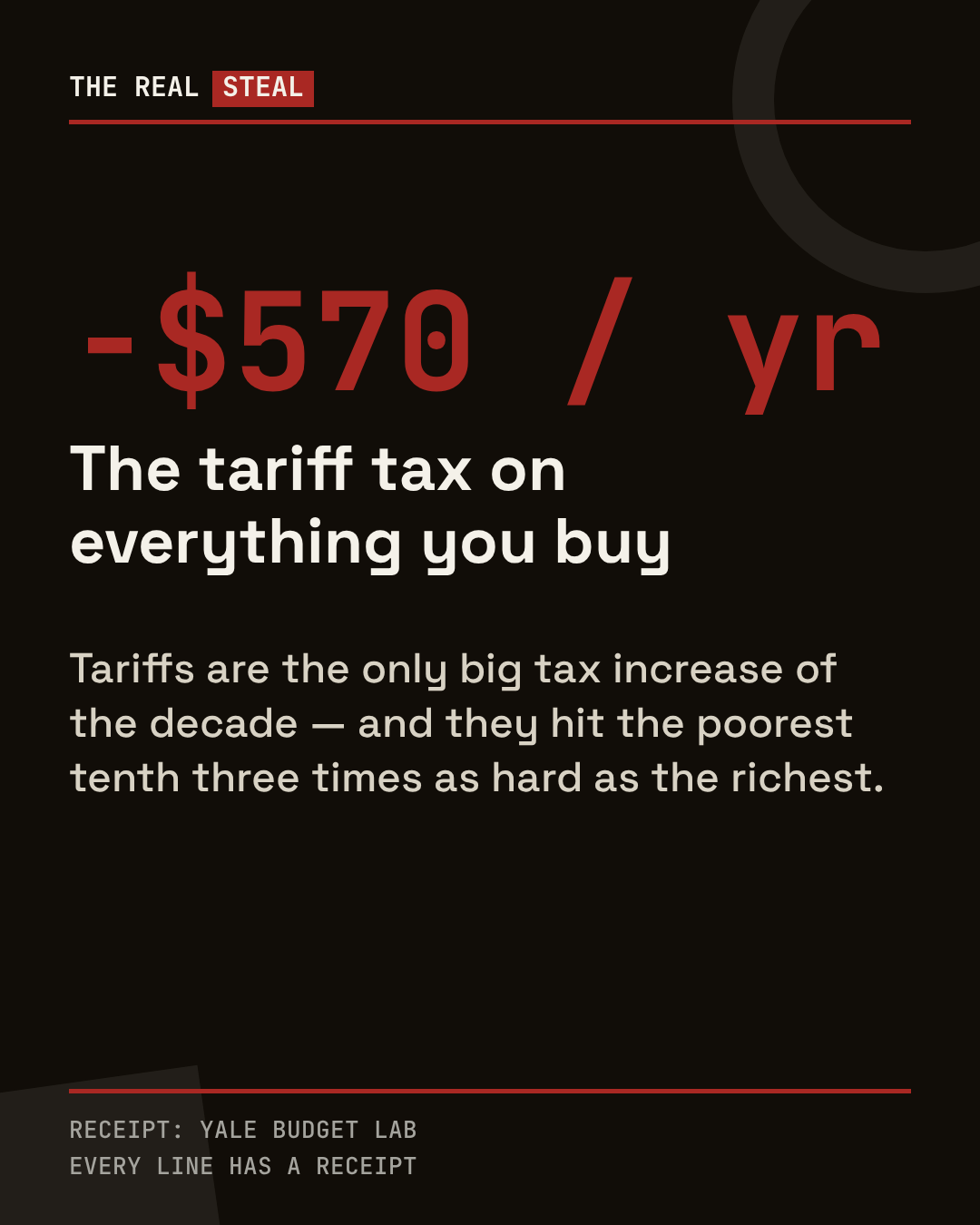
Read the brief →Yale Budget Lab estimates about $570 a year for the average household. The poorest tenth loses about three times as much income proportionally as the richest tenth.
Read the brief →Receipts Yale Budget Lab
$970 billion in FY2025 — $30,758 every second. Divided by the number of U.S. households, that is about $7,300 each, though it is not an actual per-household bill.
Read the brief →Receipts Treasury via CRFB · Treasury Debt to the Penny
Average annual change in household resources, 2026–2034 — Yale Budget Lab.
The striped bars use a different measure — the 2025 law alone — but every bar below uses the same dollar scale. Scroll right →
Decile bars: Yale Budget Lab, combined effects of the 2025 law and 2025 tariffs, average change in household resources per year, 2026–2034 (August 2025 estimates; tariff rates have shifted since — the shape has not). Top 1% / 0.1% bars: Tax Policy Center, average 2026 tax change from the law alone — a different measure, marked with hatching. And none of this counts the interest on the borrowing that paid for it — $970 billion a year, money spent servicing debt, not on anything.
Follow the forty trillion. They got the money — you got the bill. That's not borrowing. That's a heist with paperwork.
Screenshot-ready receipts. Grab one and post it — that's what actually travels.
You did the work. They took the raise. Take it back.
Get a note when the ledger moves — a new entry, a revised total, a correction. No daily digest.